Ben Gufford Ceramics

Directions Website Contact the business

Ben Gufford Ceramics Educator and Artist - Working with People, Clay, and Pixels

A pattern of lines moves across the dark surface of this chawan (茶碗). Its crackled glaze, or kannyū (貫入), invites a clos...
11/12/2026

A pattern of lines moves across the dark surface of this chawan (茶碗). Its crackled glaze, or kannyū (貫入), invites a closer look and a slower moment. In the spirit of chanoyu (茶の湯), this bowl offers a quiet reminder of ichigo ichie (一期一会). Each encounter happens only once. This chawan is available for purchase via the link below.

https://etsy.me/4C1DMUA

Sometimes a face jug becomes part of a story I never could have imagined. Chris recently wrote to tell me that a face ju...
11/09/2026

Sometimes a face jug becomes part of a story I never could have imagined. Chris recently wrote to tell me that a face jug he ordered from me arrived safely, a Christmas gift for his soon-to-be 12-year-old son and his very first face jug. His son enjoys looking through my work, especially the animations, and has spent the past few months drawing face jugs of his own. Recently, father and son worked together on a large drawing inspired by my pieces.

What touches me most is how personal his drawings are. He includes symbols from his own life, including a tree he has drawn since he was eight, one of his dad’s favorite details. After watching my animations, he began giving his face jugs legs. He’s also started naming them.

As a father and son draw together, those faces are becoming part of their shared story. Knowing my work has helped create that connection means so much to me. Thank you, Chris, for sharing this with me. I hope my face jug brings a little more joy and imagination to Christmas morning.

This chawan (茶碗, tea bowl) brings together creamy glaze, dark clay, and a softly undulating kuchizukuri (口造り, the shapin...
11/07/2026

This chawan (茶碗, tea bowl) brings together creamy glaze, dark clay, and a softly undulating kuchizukuri (口造り, the shaping of the rim). Carved lines divide the surface into irregular panels, creating a tactile rhythm around the form. Its keshiki (景色, “scenery”, the visual character of a ceramic surface) unfolds through speckles, exposed edges, and shifting glaze tones. For me, these qualities express wabi-sabi (侘寂), beauty found in simplicity, irregularity, and the traces of making.

11/05/2026

Using a Xiem clay tool, I carve lines that turn, ripple, and sweep around the curved bodies of these vases. The angular patterns recall tachinamimon (立波紋, “standing-wave pattern”), while the gently flowing grooves evoke sazanamimon (漣紋, “ripple pattern”) found in Japanese dry landscape gardens, karesansui (枯山水). Light and shadow settle into each groove, suggesting water moving across the clay.

For many years, carving my pots has been a ritual of mindfulness, patience, and meditation. Each line calls for attention to pressure, spacing, and the changing curve beneath my hand. With each repeated movement, I slow down and return to the present, one small gesture at a time.

Xiem Tools USA

“The Pattern Seer” face jug invites us to consider whether recognizing a face and recognizing an underlying order are re...
11/03/2026

“The Pattern Seer” face jug invites us to consider whether recognizing a face and recognizing an underlying order are related acts of perception. We encounter separate marks, yet experience someone looking back. Below are links to purchase and a short commentary.

https://ebay.io/m/ZJaP1h
https://etsy.me/4zvVcHe

The turquoise networks resemble cells or fitted stones; the blue circles contain smaller clusters; and the flowing ribbons, pink curls, and interlocking lavender bands suggest different ways that repetition can produce complexity. These provide a visual analogy to Michael Levin’s proposed “Platonic space”: a structured space of patterns that can find expression through different physical materials and systems. The strongest connection is in how these distinct patterns become one recognizable presence. They cross the forehead, nose, cheeks, and vessel without losing their individual rhythms, while the eyes, raised eyebrows, and gold mustache bring them together as a character. This echoes Levin’s proposal that patterns extend beyond static geometry to include organization, behavior, and potentially minds, with physical bodies serving as their interfaces. Here, clay becomes an artistic metaphor for that interface: a surface through which relationships become visible and personality becomes imaginable.

Below is a link to read Dr. Michael Levin’s “A short argument on Platonic Space: variable-agency patterns that in-form physics, biology, computer science, and cognitive science”

https://bit.ly/4kvijgm

This face jug is titled  “Measurement of Man”. Below are links to purchase and a short commentary regarding the measure ...
10/28/2026

This face jug is titled “Measurement of Man”. Below are links to purchase and a short commentary regarding the measure of humanity.

https://ebay.io/m/PRlwYX
https://etsy.me/3UqTjfI

These thinkers, Kant, Nāgārjuna, Śaṅkara, Laozi, Zhuangzi, James, Nishida, Merleau-Ponty, Dewey, and relational ethics, supply arguments and alternatives for examining ways of knowing. We can weigh both measurement and purpose, reason and experience, each open to correction. Might the self arise in fundamental consciousness, emerge through embodiment, or depend on distinctions needing reconsideration? What inquiry could distinguish them, and how can our methods foster accuracy, humility, and care?

This face jug is titled “Zero Zion.” Zero’s power is partly in allowing us to represent something that is missing. But a...
10/18/2026

This face jug is titled “Zero Zion.” Zero’s power is partly in allowing us to represent something that is missing. But absence always invites a further question: absent from what? A zero in a classroom participation record might indicate disengagement, unattentive listening, fear, or an opportunity never offered. The symbol can be exact while its interpretation remains uncertain. Perhaps one overlooked danger of numerical thinking is that precision in recording can be mistaken for completeness in understanding.

The connection between zero and Zion expresses “nothing to prove, nowhere else to be,”a sense of belonging that does not depend on achievement, status, or measurement. Zero becomes a symbol of releasing the need to define our worth, while Zion represents the spiritual home we discover in that release. Together, they suggest that we do not have to earn our place in existence, we can find peace in simply existing. Below are links to purchase.

https://ebay.io/m/a3nanO

https://etsy.me/4i3lOYK

10/10/2026

I am still “reeling” from the joy of sharing and having fun with all the wonderful workshop participants at Clay Art Vegas. Funky, fun, fantasy face jugs took the stage, and it was an honor to share the history behind this tradition.

Clay Arts Vegas Fan Page

10/07/2026

It was an honor to share my work and experiences with the Clay Art Vegas community. Connecting with fellow clay artists, exchanging ideas, and sharing the joy of creating made this such a rewarding experience. A heartfelt thank you to Thom and Peter for the opportunity and for making me feel so welcome. I’m inspired. And also grateful to have met this wonderful community and made new clay friends in Vegas. 😁

Meet Zenny the Face Jug. Below are links to purchase and a short story about Zenny. https://ebay.io/m/10cQe5https://etsy...
09/29/2026

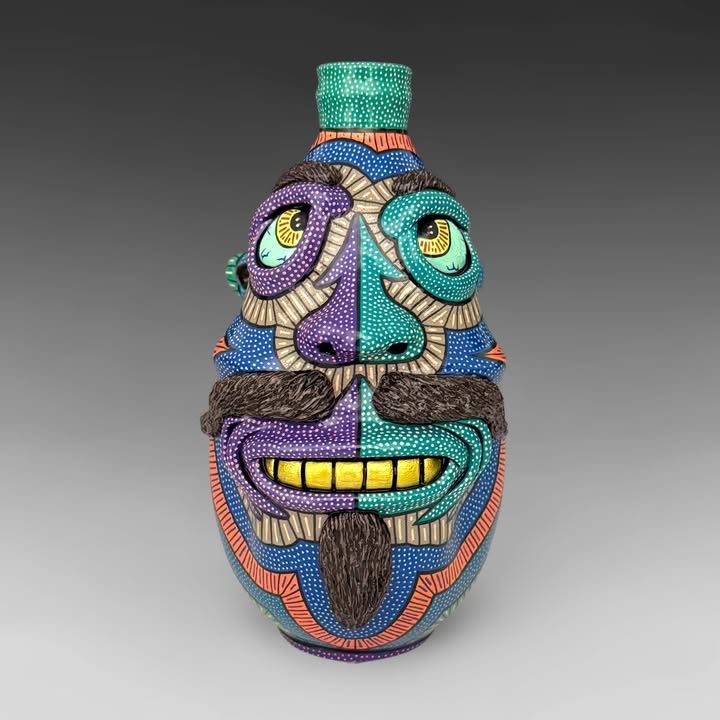
Meet Zenny the Face Jug. Below are links to purchase and a short story about Zenny.

https://ebay.io/m/10cQe5

https://etsy.me/3VebhlK

Zenny’s dotted surfaces and winding patterns suggest a mind absorbed in making. Each repeated mark invites the focused attention associated with Zentangle practice and the ease of a flow state, where the maker’s sense of time recedes into the movement of the hand. The patterns continue from Zenny’s brightly divided face around his back, asking the viewer to turn the jug and discover what a single glance cannot reveal.

That invitation echoes the emphasis in Chan and Zen philosophy on direct experience. Through a perceptionist lens, Zenny becomes more than an object to look at: meaning emerges in the relationship among maker, clay, and viewer. His many colors and forms also carry a quiet suggestion of the possibility of an underlying unity within all that appears distinct.


Address

Wilson, NC

Alerts

Be the first to know and let us send you an email when Ben Gufford Ceramics posts news and promotions. Your email address will not be used for any other purpose, and you can unsubscribe at any time.

Contact The Business

Send a message to Ben Gufford Ceramics:

Shortcuts

Share

Nearby shops